
Below-Normal 2026 Hurricane Outlook: Why Preparation Still Matters
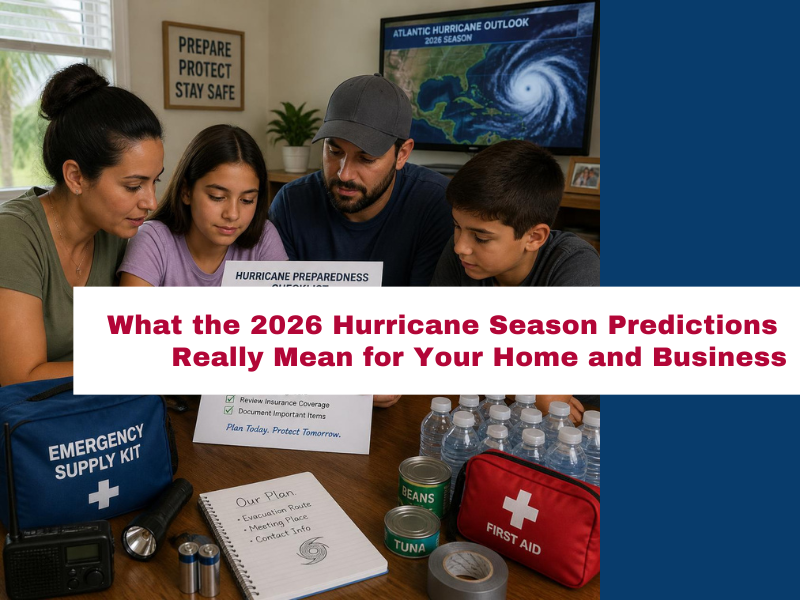
A “below normal” headline makes it tempting to relax. After several brutal seasons in a row, the prospect of a calmer Atlantic year can feel like a reason to stand down. Yet a quiet forecast does not promise a quiet neighborhood, a dry home or a power supply that holds up all week. One storm is enough to give a “below-normal” year the hardest week your family or company has ever faced.
Below we look at what the 2026 outlook actually says, why experts still wanted everyone to get ready, and some easy, calm-weather steps worth taking before any storm appears.
NOAA’s 2026 Outlook
Forecasters at NOAA’s National Weather Service published their outlook in May 2026 for the season running June 1 through November 30. They expected Atlantic hurricane activity to be below normal, giving a 55 percent chance of a below-normal year, a 35 percent chance of a near-normal one and only a 10 percent chance of an above-normal season.
Put into numbers, the forecast called for named storms numbering 8 to 14. Between 3 and 6 of them could strengthen into hurricanes, with 1 to 3 becoming major hurricanes at Category 3 or above. An average season, by comparison, brings seven hurricanes from 14 named storms. The complete outlook is set out in NOAA’s news release on the 2026 season.
The calmer outlook was mainly down to an El Niño that was taking shape, a climate pattern that usually holds back storm formation in the Atlantic. For the science behind it, the ENSO blog on NOAA’s Climate.gov describes how La Niña and El Niño each shape a season.
What People Get Wrong About “Below Normal”
A seasonal outlook estimates how busy the Atlantic basin as a whole will probably be. It gives no indication, and could not give one, of where or when any storm will come ashore. NOAA states this plainly: the outlook does not forecast landfalls.
That difference counts for more than any number in a headline. Even a season below normal can steer one strong hurricane directly toward your town. A smaller total number of storms does nothing to reduce the danger to your street if your street ends up in the path.
The past shows this more clearly than any statistic can. By the numbers, the 1992 season came in below normal, with comparatively few named storms, yet it also brought Hurricane Andrew, which reached Category 5, caused devastation across South Florida and still ranks among the most expensive hurricanes in US history. Ken Graham, director of NOAA’s National Weather Service, made the point in 2026 that one storm is enough to make a season a very bad one, which is why it is essential to go over your preparedness plan early.
The lesson is straightforward: plan around your own risk, not around the forecast.
A Calm Forecast Is a Chance to Get Ready
A quiet forecast has one real benefit: it gives you the easiest conditions you will ever have for getting prepared. Getting ready in June, coffee in hand and nothing on the radar, is relaxed, inexpensive and thorough. Getting ready during the final 48 hours before a storm makes landfall is stressful and costly, and it often comes too late, with long lines and bare shelves.
Treat the lull as an opportunity rather than an excuse. The households that come through storms most smoothly are nearly always the ones that finished their preparations before any cone of uncertainty showed up on the evening news.
A Relaxed Checklist for Hurricane Readiness
There is no need to tackle everything in a single weekend. Spread these tasks out over the calm weeks before any storm forms.
Put together or update your kit. Plan for a minimum of three days of water at one gallon per person each day, along with non-perishable food. Include medications, a first-aid kit, flashlights, batteries and a radio that runs on batteries or a hand crank. Ready.gov maintains a regularly updated list of basic disaster supplies that is worth saving.
Agree on a communication plan for family and work. Choose a meeting place and decide how you will contact each other if you get separated and the phone lines are overloaded. Check that everyone, children included, understands the plan. Free templates are available in the family communication plan from Ready.gov.
Learn your zone. Check whether your home sits inside an evacuation zone and get to know your routes well before you might need them. Start with your county’s emergency management website; once a system forms, the National Hurricane Center provides authoritative live tracking.
Safeguard important documents. Keep IDs, insurance papers and medical records together in one waterproof folder, and keep digital copies you can open on your phone. Look over your insurance early too, since standard homeowners policies usually do not cover flood damage.
Think about power. Outages are among the most frequent and disruptive effects of any storm, even one that only grazes your area. Work out how your household would cope if the electricity went out: how you would charge phones, keep food chilled and run any medical equipment. Some families will manage with a few power banks; for others, particularly households that run a business from home or rely on medical devices that need power, a backup power source belongs in the plan.
Include every member of the household. Pets need a carrier along with food and water. Infants will need supplies and formula. Elderly or vulnerable relatives may need specific medications planned for and extra time allowed.
When the Power Goes Out
For most people an outage is a nuisance. Some face a real danger, and many small businesses lose goods, income and customers to even a brief one. With a backup power source, what is usually one of the hardest parts of a storm becomes a non-event: the refrigerator keeps food cold, phones keep their charge, medical devices continue to run, and the household or business keeps going while the grid is restored.
If your plan includes keeping the lights on through the season, our team is glad to go through the options that suit your home or business. Call us on +1 251-314-4812 for straightforward advice with no pressure.
In Short
A below-normal outlook really is good news, but it is no reason to skip getting ready. The 2026 forecast suggested the basin would probably be quieter; it cannot tell you whether your own community will face the one storm that bucks the trend. Use the calm weeks to prepare at an unhurried pace, so your family and business stay calm, safe and ready for whatever the season delivers.
Stay safe.