Military-Grade Generators: What Commercial Buyers Need to Know
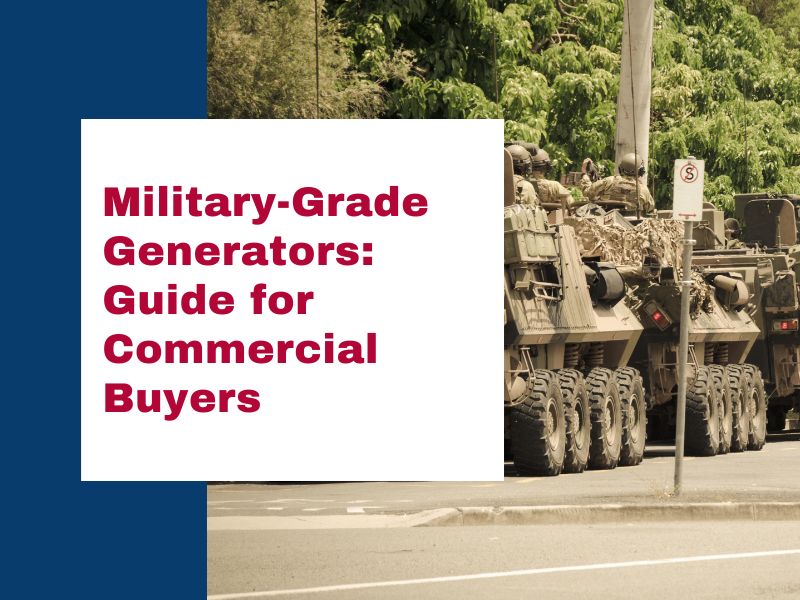
Power continuity is a non-negotiable for many commercial operations. When a data center goes dark, a manufacturing line stops, or a medical facility loses power, the consequences are immediate and costly. For buyers who need generators that will not let them down under pressure, military-grade units are increasingly entering the conversation.
But what does military-grade actually mean, and does the specification translate to a commercial or industrial setting? This guide covers everything commercial buyers need to know: the standards behind the label, the practical advantages, the limitations, and how to source the right unit for your application.
What ‘Military-Grade’ Actually Means
The term military-grade refers to generators designed and tested to meet U.S. Department of Defense (DoD) specifications, commonly referred to as MIL-SPEC or MIL-STD standards. These are not marketing claims; they are published, enforceable technical requirements that equipment must meet before it is accepted into military service.
Relevant standards for commercial buyers to understand include:
- MIL-STD-461: Governs electromagnetic interference (EMI) and electromagnetic compatibility (EMC). Equipment certified to this standard will not disrupt sensitive electronics nearby and is resistant to interference from external sources. The current revision is MIL-STD-461G (2015).
- MIL-STD-810: Covers environmental testing across temperature extremes, humidity, altitude, vibration, shock, and dust exposure. A generator tested to MIL-STD-810 has been verified to function across a wide range of harsh conditions.
- MIL-STD-1275: Addresses power quality and transient requirements, particularly relevant for vehicle-mounted and tactical applications.
For most commercial and industrial buyers, MIL-STD-461 and MIL-STD-810 are the most directly relevant. The former matters if you are running sensitive electronics, communications systems, or server infrastructure. The latter matters if the unit will operate in any environment that is not a controlled indoor space.
Why Commercial Buyers Are Looking at Military Generators
The military generator market was valued at approximately USD 1.5 billion in 2025 and is projected to continue growing, driven by increasing reliance on electronic systems requiring uninterrupted power. Increasingly, commercial facilities are recognising that the engineering principles behind these units deliver real advantages in demanding operational contexts.
Built for Conditions That Would Degrade a Standard Unit
Military generators are engineered for environments most commercial equipment is never tested against: extreme heat and cold, sustained vibration, moisture, dust, and shock. For commercial buyers operating in coastal locations, construction sites, remote facilities, or industrial environments, this level of environmental resilience translates directly to longer service life and lower maintenance costs.
Consistent, Clean Power Output
Military specifications require tighter tolerances on voltage and frequency stability than many standard commercial generators. For operations running precision manufacturing equipment, server infrastructure, or medical devices, clean and stable power output matters. A heavy duty generator built to military specification will typically maintain output quality under rapidly shifting load conditions more reliably than an equivalent commercial standby unit.
Extended Continuous Run Capability
Standard commercial standby generators are rated for periodic emergency use. Military generators are built for continuous or prime power operation over sustained periods. This distinction is important for facilities that may face prolonged outages, that operate in locations without reliable grid access, or that require a generator as a primary rather than backup power source. Prime power generators rated to military specification are among the most robust options available for these use cases.
Surplus Units Represent Strong Value
Surplus military generators offer a route to military-grade capability at a fraction of the cost of new commercial equivalents. Many units available on the surplus market have low operating hours, have been maintained under rigorous military service schedules, and originate from major manufacturers. For budget-conscious commercial buyers, this is a compelling alternative to new procurement.
Key Specifications to Evaluate Before You Buy
Whether you are considering a new military-specification unit or a surplus military generator for sale, focus your evaluation on the following areas.
[Power Output and Capacity
Military generators span a wide capacity range, from small 5 kW tactical units to large base-operation sets of 500 kW and above. For most commercial applications, the 60 kW to 500 kW range is most relevant. Accurate load calculation is essential before selecting capacity. A 500 kW generator may be the right answer for a data center application; a 60 kW to 100 kW unit may be sufficient for a smaller commercial building requiring backup cover.
[H3] Fuel Type and Fuel System
The majority of military generators run on diesel. Diesel remains the standard for large commercial and industrial diesel generators due to its energy density, storage stability, and wide availability. Some military units are configured for JP-8 or multi-fuel operation, which may require adjustment for standard commercial diesel fuel supply. Confirm fuel compatibility and check whether the unit includes a belly tank or requires external fuel storage.
Single-Phase vs. Three-Phase Output
Most commercial and industrial facilities require three-phase power. Verify output configuration before purchase. The majority of larger military generator sets produce three-phase output at 60 Hz, consistent with U.S. commercial requirements, but this should always be confirmed for the specific unit.
Enclosure and Ingress Protection
Military enclosures are typically ruggedised to high ingress protection (IP) standards for dust and moisture resistance. For outdoor commercial installations or harsh internal environments, this is a material advantage over standard commercial enclosures. Confirm the IP rating and check for any enclosure condition issues on surplus units.
Transfer Switch and Control System Compatibility
Verify compatibility with your existing automatic transfer switch (ATS). An automatic transfer switch for a generator in a commercial building is the interface between your generator and your building’s electrical system. Older surplus military units may require control system updates or additional integration work to connect with modern building management systems. Factor this into your total cost calculation.
[H2] What Commercial Buyers Should Watch Out For
Military-grade does not mean ready to install without consideration. There are practical factors that require planning before committing to a purchase.
Size and Weight
Military generators are built for durability rather than ease of movement. Large units can be significantly heavier than commercial equivalents of comparable output. Site preparation, foundation requirements, and logistics costs should be factored into total cost of ownership before purchase.
Parts Availability and Servicing
Parts availability and qualified servicing are important considerations for any surplus unit. Where a generator uses a well-known commercial engine platform such as Cummins or Caterpillar, generator parts and service support are widely available. Units built around proprietary military engine variants require more planning. Confirm the engine make and model and check parts availability before committing.
EPA Emissions Compliance
Older surplus military generators may predate current EPA Tier 4 Final emissions standards. Depending on your state, your application (standby vs. prime power), and your hours of operation, this may or may not be a regulatory issue. Discuss your specific situation with your supplier and local authority having jurisdiction (AHJ) before purchase.
Noise
Military generators are engineered for operational reliability rather than low acoustic output. If your facility is subject to noise ordinances or is adjacent to noise-sensitive operations, review the acoustic specification carefully and budget for enclosure or attenuation measures if required.
Commercial Applications Well Suited to Military-Grade Generators
Military-grade units are a strong fit for a range of commercial and industrial applications:
- Data centers and co-location facilities requiring stable, low-distortion power with reliable automatic transfer on outage
- Critical infrastructure including water treatment, wastewater, and telecommunications where continuity is a regulatory and safety requirement
- Remote construction sites, mining operations, and oil and gas installations requiring prime power in challenging environments
- Manufacturing and industrial facilities with high electrical loads and zero tolerance for interruption
- Healthcare, research, and laboratory facilities where power quality and continuity are non-negotiable
- Government, defense contractor, and secure facility installations where MIL-SPEC compliance is a procurement requirement
- Commercial buildings requiring a backup generator solution that can carry full building load through extended outages
New vs. Surplus Military Generators: How to Decide
For most commercial buyers the question is not whether to choose military-grade, but whether to source new or surplus.
New military-specification generators offer the most current technology, full manufacturer warranty coverage, and straightforward compliance with current emissions standards. They are the right choice where the latest specification is required, where a long warranty horizon is important, or where financing a new asset is preferable to a capital purchase.
Surplus military generators for sale offer compelling value where budget is a primary consideration and the buyer has the technical capability to inspect, assess, and integrate the unit. Many surplus units are available with low hours, have been maintained under documented military service schedules, and originate from leading manufacturers. At Global Generator Supply, surplus units are inspected and assessed before sale.
How to Source the Right Military Generator for Your Application
Work With a Specialist Supplier
Military generator procurement is not the same as sourcing a standard commercial standby unit. A specialist supplier will understand the relevant specifications, can provide condition documentation on surplus units, and can advise on integration requirements for your specific application.
Request Full Documentation
For any unit, request maintenance records, operating hours, service history, and original specification sheets where available. For surplus military generators for sale, this documentation is your primary due diligence tool.
Factor in Total Cost of Ownership
Acquisition cost is one element. Factor in delivery and logistics, site preparation, installation, transfer switch integration, generator service and repair requirements, parts costs, fuel storage infrastructure, and any emissions compliance work required. A lower purchase price can be quickly offset by higher integration costs if these are not planned for in advance.
Arrange a Load Test Before Acceptance
Where possible, arrange for a full load test on any unit before final acceptance. Load testing under realistic conditions will surface any issues before the unit is required to perform in an actual outage. This is standard practice for new commercial units and equally important for surplus military generators.
Talk to the Global Generator Supply Team
Global Generator Supply supplies commercial and industrial power solutions across the United States, including military-grade and surplus military generators across a wide range of capacities and configurations. Whether you are evaluating a specific unit, sizing a new installation, or working through your requirements from scratch, our team can help.
Contact us to discuss your application or to request information on current inventory.