Customized Generators: Why One-Size-Fits-All Power Solutions Fall Short
When it comes to backup power, off-the-shelf generators rarely meet real-world demands. For many scenarios, customized generators offer a solution tailored to your specific needs. Every facility, operation, and load profile is different — and relying on a standard configuration can lead to inefficiency, overspending, or power failure when it matters most.
Customized generators are designed around your exact electrical requirements, operating conditions, and long-term goals, delivering power solutions that are reliable, scalable, and built for purpose.
What Is a Customized Generator?
A customized generator is a standby or prime power system engineered to match specific site conditions and power requirements, rather than a generic, pre-configured unit.
Customization may include:
- Generator sizing based on real load calculations
- Fuel type selection (diesel, natural gas, propane, hybrid)
- Enclosure and environmental adaptations
- Paralleling and redundancy configurations
- Control systems, monitoring, and integration
- Compliance with local codes and industry regulations, like UL2200 certification or Tier 4 Final Engines.
The result is a generator system that performs efficiently under real operating conditions; not theoretical ones.
Why Standard Generators Often Miss the Mark
Standard generator packages are built for average use cases. In practice, most applications aren’t average.
Common problems with non-customized generators include:
- Oversizing that wastes fuel and increases wear
- Undersizing that leads to overloads or shutdowns
- Incompatible fuel or runtime limitations
- Poor fit for space, noise, or environmental constraints
- Limited scalability as operations grow
Customization solves these issues by aligning the generator system with how power is actually used.
Key Areas Where Generator Customization Matters
1. Load Requirements & Power Demand
Accurate load analysis is the foundation of any customized generator system.
Customization accounts for:
- Starting vs running loads
- Critical vs non-critical circuits
- Surge demands from motors, HVAC, or industrial equipment
- Future expansion and load growth
This ensures reliable performance without unnecessary oversizing.
Also read: What Size Generator do I need?
2. Fuel Type & Runtime Strategy
Different applications demand different fuel strategies.
Customized systems allow you to:
- Select diesel, natural gas, propane, or dual-fuel setups
- Design for extended runtime or rapid refueling
- Balance fuel availability, cost, and emissions
- Meet site-specific safety or regulatory requirements
Fuel flexibility is often essential for commercial and industrial operations.
Also read: Diesel vs Natural Gas Generators: Which is Best for Your Application
3. Environmental & Site Conditions
Generators don’t operate in ideal environments; they operate where your facility exists.
Customization can address:
- Extreme heat or cold climates
- High humidity, dust, or corrosive conditions
- Noise restrictions and sound attenuation
- Limited footprint or rooftop installations
- Seismic or wind load requirements
Ignoring environmental factors shortens equipment life and increases downtime risk.
Also read: 6 Steps for Your Generator Installation Checklist
4. Enclosures, Sound & Aesthetics
For many facilities, noise and visual impact matter as much as power output.
Custom enclosure options include:
- Weather-rated or sound-attenuated enclosures
- Hospital-grade or residential-friendly designs
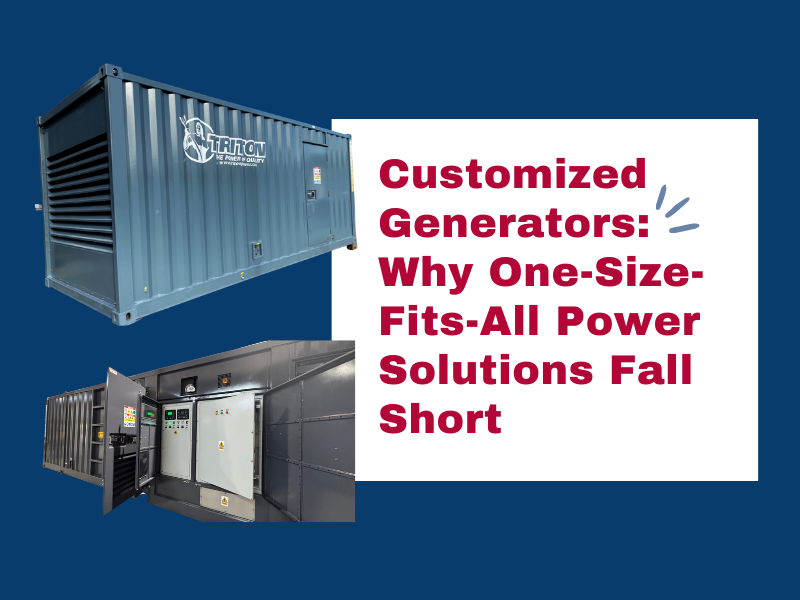
- Skid-mounted or containerized systems
- Custom access panels for service efficiency
These choices improve compliance, safety, and long-term usability.
5. Controls, Monitoring & Integration
Modern generator systems are rarely standalone assets.
Customization enables:
- Advanced digital control panels
- Remote monitoring and alerts
- Integration with building management systems (BMS)
- Automatic transfer switches and load shedding
- Paralleling for redundancy or capacity scaling
This level of control improves uptime and simplifies maintenance.
Generator Controls & Monitoring Systems
6. Redundancy, Paralleling & Scalability
For mission-critical operations, failure is not an option.
Customized configurations can include:
- N+1 or redundant generator systems
- Paralleled generators for load sharing
- Phased expansion without full system replacement
Scalable design protects long-term investment and supports business growth.
Who Benefits Most from Customized Generators?
Customized generator solutions are especially valuable for:
- Commercial buildings and campuses
- Healthcare and life-safety facilities
- Data centers and IT infrastructure
- Manufacturing and industrial operations
- Municipal and utility applications
- Facilities with complex or fluctuating loads
In these environments, power reliability isn’t optional; it’s operationally critical.
Customized vs Standard Generators: A Practical Comparison
| Standard Generator | Customized Generator |
| Sized for averages | Sized for actual load |
| Limited configuration | Engineered for site conditions |
| Minimal scalability | Designed for growth |
| Higher risk of inefficiency | Optimised performance & fuel use |
| Shorter lifecycle value | Long-term reliability & ROI |
Planning a Customized Generator Solution
A successful customized generator project starts with:
- Load analysis and power assessment
- Site evaluation and environmental review
- Fuel strategy planning
- Compliance and code requirements
- Future capacity considerations
Working with experienced generator specialists ensures the system is designed correctly from day one.
Power Built for Your Operation
No two facilities use power the same way — and your generator shouldn’t be generic. A customized generator solution delivers reliability, efficiency, and flexibility that off-the-shelf systems can’t match.
If your operation has specific power demands, environmental constraints, or future growth plans, customization isn’t an upgrade — it’s the right starting point.